A space I already had, and a use the code had never named
In 2018 I had the rear of a single-story industrial building on Placentia Avenue in Costa Mesa, the space my design-build company, Tellus, used behind a front tenant that repaired cars. Zoned general industrial, inside the Mesa West Bluff plan, underused. Axe throwing had proven itself as a paying category in Canada and the eastern United States, and nothing like it was open anywhere near Orange County. I read the code on the building before I did anything else. The city's land use matrix had no line for indoor axe throwing. Not prohibited, not permitted, absent. That is a different problem from a permit. A permit has a form and a fee; this had neither.
The rear suite became the room below. Guests who threw there still show it on the venue's public Yelp listing, photos and reviews together.
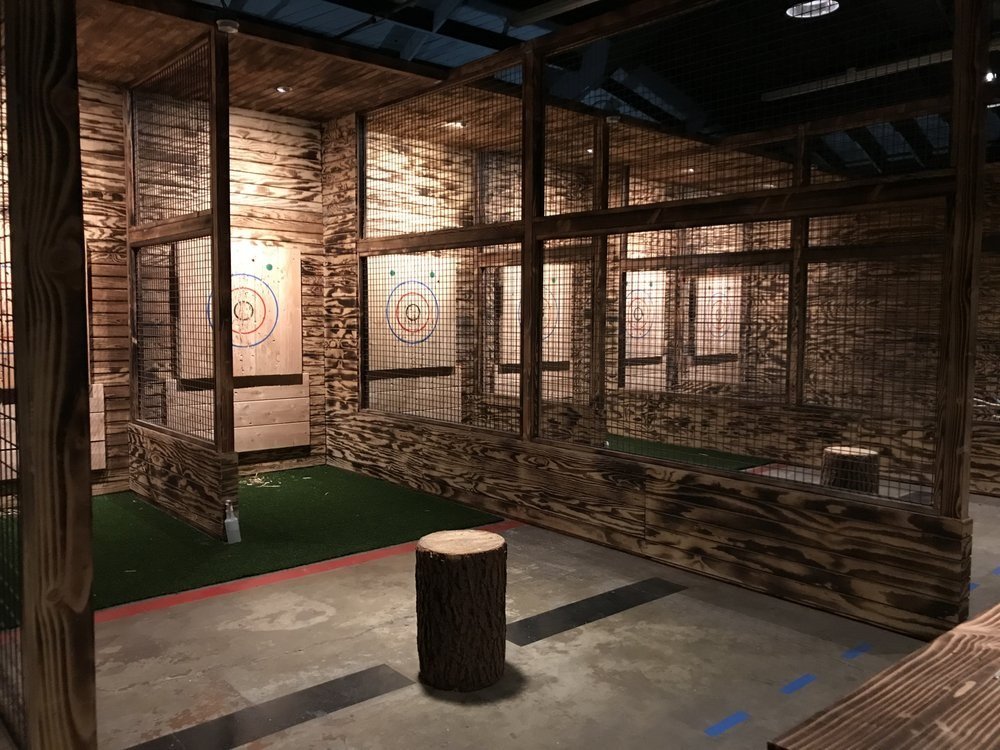
The people in it were the ones who would have to say yes. Costa Mesa's planning staff cannot approve a use because they like the argument. Under California law and the city's own code, a conditional use permit issues only on findings of fact, three of them, that the Planning Commission adopts: the use is compatible with the area, it is not detrimental to health, safety or welfare, and it fits the general plan. Staff draft those findings into the report the commissioners vote on. If staff cannot write a finding, the commission cannot adopt it, and the application dies on paper no matter how good the case was. Behind staff sat the neighbors: the auto shop sharing the lot, and live-work lofts across the property line.
What the venture actually needed, then, was not persuasion. It was a fact staff could cite under each finding. Where a use has local precedent, an analogy works as a citation, because staff can point at a prior approval and say this is like that. Where there is no precedent, an analogy is an argument, and it asks the planner to build the factual basis for a finding out of a comparison, under time pressure, with a neighbor already unhappy. The only way to make a citable fact exist about a use that had never existed there was to run the use.
Prove it first, then paper it
There were two ways in. The industry default is to retain land use counsel, build the application on an analogy, an archery range, a bowling alley, file it by mail, wait for the hearing, and only then build out and open. It is cheaper in fees and it costs the owner nothing in time, and it clears constantly in California for uses the code already names. Here it had nothing under it. The hearing would have been about a hypothetical, in front of a commission that had never seen the thing, with the safety finding resting on a comparison to a sport nobody in the room had watched.
The other way was to open. Convert the space, file the brand, book private groups and parties, and run it long enough that the operation itself, its session structure, its hours, its staffing, its rules, became the evidence. Build the brand, build the market, incorporate after. The risk was plain, and it landed: the city could tell us to stop, and it did. I took that risk on purpose. A category with no patent, no network effect and no switching cost has nothing durable but a head start, so the months in front of the market were worth more than the certainty a mailed application would have bought, and when the hearing came it would be about something real.
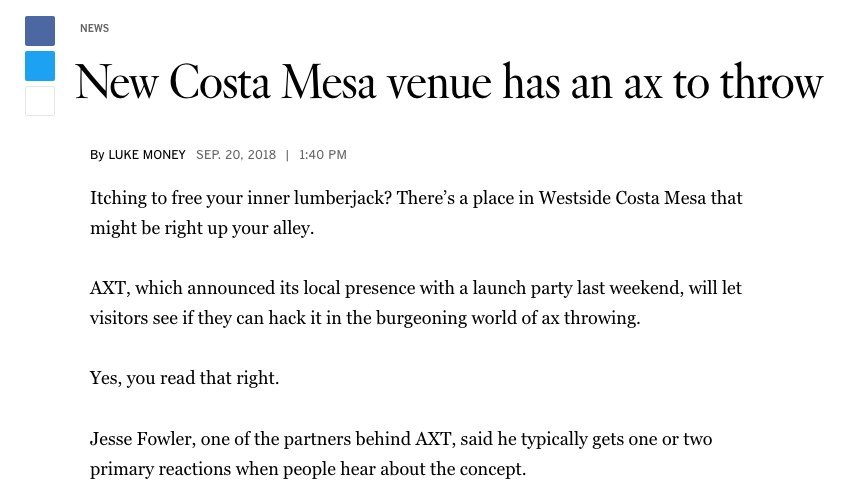
We opened, and the local paper came. The Daily Pilot's story of September 20, 2018, kept in the Internet Archive, covered the launch party and the lanes behind the auto shop on Placentia Avenue.
How I came at this one
The first question was what a finding physically needs before anything gets filed: a fact staff can write down, not a case they can be persuaded by. That question fit because the code had no category and no precedent, so the industry default, an analogy filed by counsel, had nothing under it. The second question was where the decision would actually be made, and the answer was a hearing room with neighbors in it, so I went myself.