The work, in the order it ran
1. Read the code on the building. Known: a general industrial zone, a multi-tenant building with a car-repair shop in front and our design-build space at the rear. Unknown: whether the use was listed anywhere. It was not, and the code's route for an unlisted use is a discretionary permit with findings. What that changed: the first move was not an application. There was nothing yet for an application to cite.
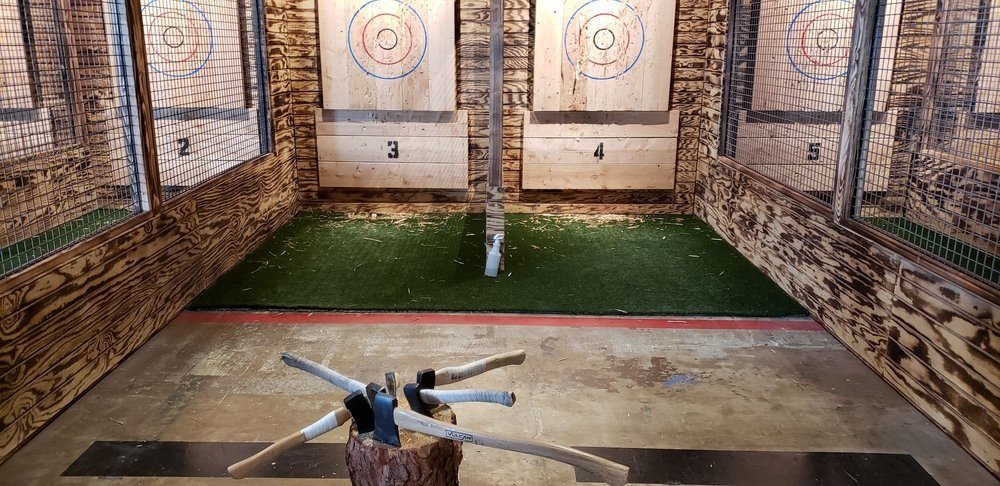
2. Convert the space and open on bookings. Eight lanes, a lounge and a storage room went into the rear suite. Sessions were reservation-only, one or two hours, twenty-one and over, with a signed waiver, and an instructor on every pair of lanes, an AXTpert, walked each group through the rules and the safety protocol before anyone touched an axe, on the National Axe Throwing Federation's guidelines. Private events and groups came first because they book ahead and pay as a group. The doors opened in October 2018.
3. File the brand wider than the room. The AXT word mark and logo went to the USPTO across event promotion, leagues, apparel, lessons, mobile rentals and venue operation, and were allowed in March 2019. The room was the proof; the brand was the asset. That distinction is the whole reason the buyer's offer, when it came, looked the way it did.
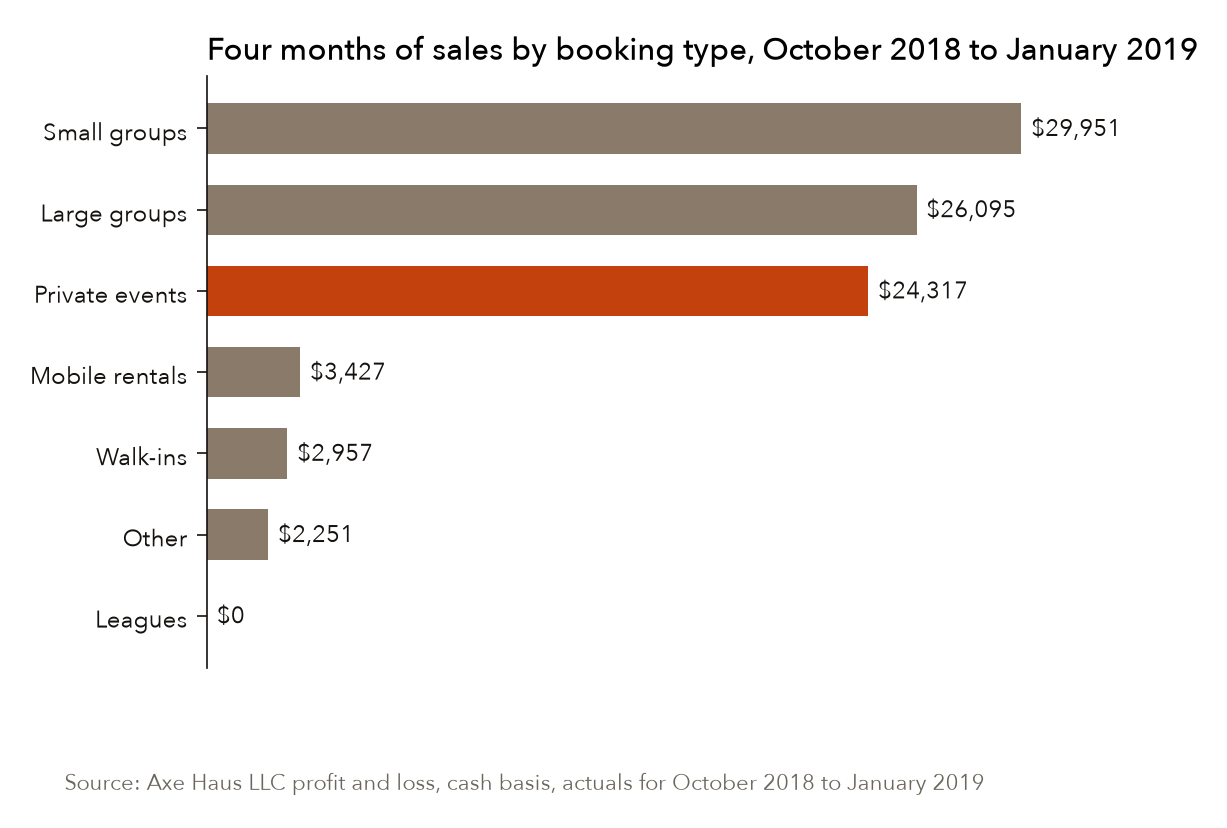
4. Read what the parties proved. The figure below is the first four months by booking type. Small groups, large groups and private events were nine of every ten dollars. Leagues never started, and walk-ins and mobile rentals barely registered before the doors closed. The first month lost money and the next three made it back and more. The party business was proven; the walk-in business was a hope.
5. When the city said stop, stop. In November 2018 a neighbor complained about noise and the city opened a code enforcement case: the venue was operating without a business license. There was no license category to have applied under; that is what an absent use means in practice. I closed the doors in January 2019, kept paying the rent, and spent the spring turning four months of operation into an application. It was filed June 12, 2019. Arguing with code enforcement about a use the code does not name is a fight with no referee. The referee was the commission, and the way to it was the finding.
6. Build the packet the way staff write findings. Under each of the three findings went a fact from the running venue, and next to it the condition that made the fact writable. Compatibility: the venue ran in the evenings and on Sunday and Monday, when the shop next door was closed, so the lot was never shared, with an on-site valet and a gap between sessions so an arriving group never met a departing one in the lot. Safety: everything indoors with the roll-up door shut, federation rules, a staffing minimum, no alcohol, no food, a nine o'clock close, a mat under the targets and a planted screen wall on the side facing the lofts. General plan: an industrial zone that already admits arcades, gyms and firing ranges through the same discretionary route, and a leisure use that keeps an industrial building occupied. Where the code already had a number to borrow, the bowling-alley parking rate, the analogy worked as a citation and staff used it. Where it did not, the safety finding, only the operating record could. The map of findings, facts and conditions is Attachment B.
Give the person who has to write the decision the fact they need, not the case for why they should agree with you.
7. Go to the hearing myself. Staff recommended approval. The Planning Commission heard Planning Application 19-18 at a special meeting on November 14, 2019, and there was a lot of pushback in that room, from the dais as much as the floor. It approved the permit, with a valet condition and the operating conditions we had proposed, three votes to two, the chair among the noes. A mailed file gets a mailed answer. A room can be moved, and it can also be lost by one vote, which is why the person whose operation the findings describe should be the one standing in it.
8. Retrofit to the conditions, and take the buyer's call. Through the winter we rebuilt the suite to the permit's conditions and set a reopening for March 2020. Word had travelled, and requests to partner came in from operators who wanted into the category. A buyer out of Riverside wanted the brand, the concept, every unit, the equipment and the website, and we agreed terms by handshake on a Friday in March 2020. COVID closed the state the following Monday.
The soft opening against the reopening plan
In January 2020, with the permit in hand and the retrofit under way, I built the plan for the reopening year, April 2020 to March 2021, from the four months of actuals. The figure sets the two against each other per month. The soft opening had run at 59 percent of the sales pace the plan required and 67 percent of the net pace, and its net margin was three points better than the plan assumed. Read both directions, that says the venue knew what it cost to run better than it knew how many people would come, so any correction was a demand problem, traffic and bookings, not a cost problem. Two cautions belong beside the figure. The books are cash basis, so the build-out is not in the net figure. And October to January is party season for a group venue, so a flat annualization of those months flatters the walk-in lines, not the other way round.
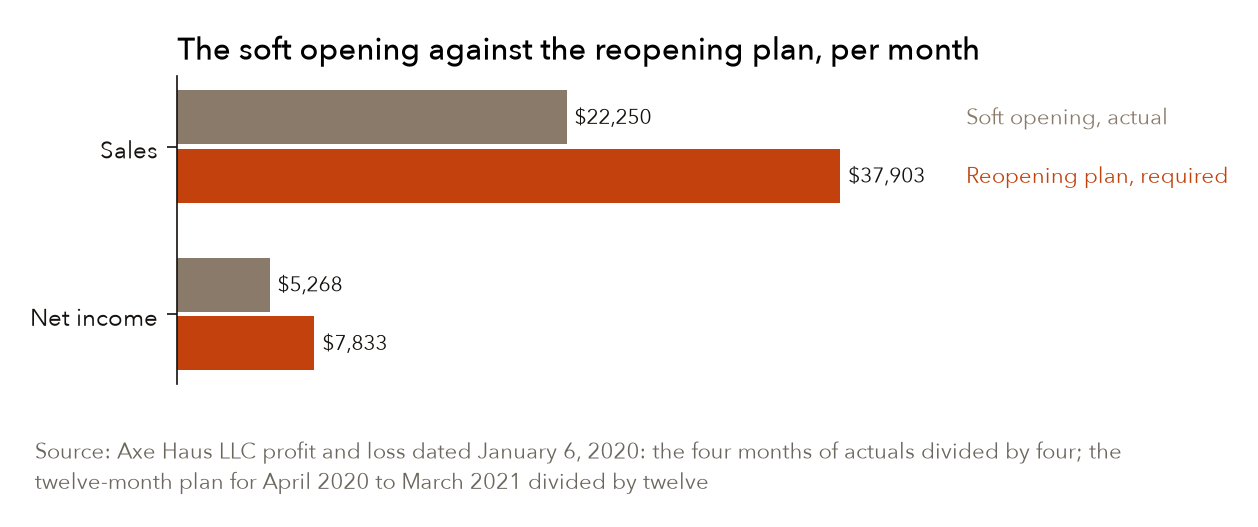
The number I would have watched is not on the chart. About a fifth of the plan sat in leagues, walk-ins and mobile rentals, the three lines that had produced seven percent of the soft opening's sales, and the permit's conditions, reservation-only sessions, an early close and hours fitted around the neighbor's shop, made exactly those lines harder to grow. A buyer was buying a proven party business and an unproven walk-in one, and I would have said so to the buyer, because the proven part was the whole reason there was a buyer.
What I kept, and what the city's process never needed changed
The city's process was not the fault, and I did not try to change it. It was fed correctly for the first time for this use. The faulty logic was the applicant's, mine at the start, in treating a discretionary approval as something to be argued. A denial with adopted findings is precedent against the next applicant at every address in the city, so it had to be right on the first hearing, and right meant citable.
What I kept is the packet method, and I have used it since. Learn, before writing a word, which findings the body must adopt, in the code's words. Under each, supply a fact from operations, not from comparison, and if the fact does not exist yet, go make it exist. Borrow the code's own numbers where it has them, and say so; that is where analogy is a citation. Write the conditions yourself, because a condition you propose is a finding staff can write and a condition imposed on you is a negotiation you lost. Then show up. I had run a version of this once before, in 2016, when Carson froze new construction and Tellus won one of the few exemptions by giving the city the narrative it needed and the documentation behind it. Costa Mesa is where it became a method rather than an instinct.
The operating system the venue ran on afterwards was the permit itself. Reservation-only sessions, an instructor on every pair of lanes, the hours, the valet, the gap between groups: the conditions were the operations manual, which is the quiet advantage of writing them.
What it cost to hold the line, and what I would watch
The line was that the operation would be the evidence, and holding it cost four and a half months of trading and then ten months dark, with rent paid on a closed room, new plans and permit fees, and a crew of twelve I meant to bring back. The permit came with conditions that shaped the business for good: no alcohol in a party venue, a nine o'clock close, hours tied to when the neighbor's shop was shut, a valet on every night the doors were open. Those were the price of a writable safety finding, and I would pay it again, because the alternative was a hearing about a hypothetical in front of a commission that split as it was.
Then the Friday and the Monday. The terms with the Riverside buyer stayed a handshake, and the shutdown killed the close. The shutdown ran six to nine months, group gatherings were the first thing to go and the last to return, and a venue that lives on people standing shoulder to shoulder had no version of itself that fit the year. What the buyer had wanted was the brand, the units, the equipment and the website, not the address, and that is the part of this I would point a reader at. A conditional use permit runs with the property; it was never the asset. The asset was a proven concept, a filed brand, a trained crew and a method for getting a city to say yes to a use it had never seen, and every one of those left the building with me.
What I would watch, in this venue or in any like it: the three lines the plan leaned on and the soft opening had not proven; the neighbor, because the noise complaint was the only thing that ever actually stopped the business; and the calendar, because a category with only a head start is easiest to sell at the top of its novelty, and the top of ours was a Friday in March. AXT did not end with that week, which is the last part of this report.
The file is still open
The 2018 to 2020 story above is the first chapter, and I tell it as history: the owner-operator years, the permit and the handshake. It is not the whole engagement. AXT is a current engagement, and I hold a long-term position in it. I treat it as a long-term play, not a sale to be timed.
That follows from the read in the section above. The asset was never the permit or the address; it was the brand, the concept and the method, and all of them left the building with me. A proven concept does not stop being proven because one close died in a shutdown. The head start is spent; the brand and the method are not, and they are worth more to someone who is patient with them than to someone who needs them sold.
The brand still has its own public pages, on Facebook, on Instagram and in a Tripadvisor listing. The mark below is the brand's own.

What it produced
$88,998.95 of sales and $21,072.85 net in the first four months. Costa Mesa's first use permit for indoor axe throwing issued November 14, 2019, three votes to two. A handshake sale with a Riverside buyer the Friday before COVID closed the state; the shutdown killed the close. The permit ran with the property, but the brand, the concept and the method left the building with me, and AXT continues today as a long-term position.
A slice of the project list
A few related projects.
- Greensleeves Steakhouse: co-owner and operator, a landmark restaurant turnaround (2016 to 2022)
- Sublime Medical: fractional Chief Operating Officer, a medical aesthetics practice (2015)
- Contractor Gorilla: advisor with an equity position, a marketing agency built for contractors (2014 to 2017)
- The Triangle, Grand Avenue: feasibility and go-to-market, capital last (2026)